
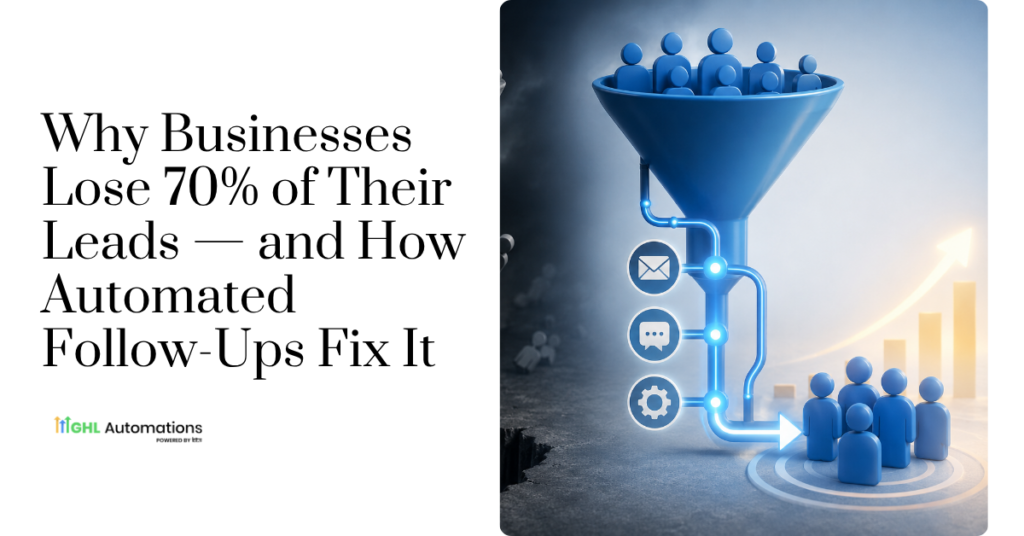
You’re spending money on ads, SEO, and lead generation. Leads are coming in. But the sales numbers don’t match. The problem almost certainly isn’t your marketing — it’s what happens after the lead arrives.
Most Businesses Have a Follow-Up Problem, Not a Lead Problem
Here’s a number that should stop you: nearly three-quarters of all internet leads are wasted because businesses fail to follow up adequately. Not because the leads were bad. Not because the product wasn’t right. Simply because no one responded fast enough — or at all.
And it gets worse. According to research by InsideSales.com and MIT, 78% of customers purchase from the first company that responds to their inquiry — not the cheapest, not the most experienced, just the fastest. In most industries, your leads are reaching out to 3–5 competitors at the same time. The business that replies first gets the conversation. Everyone else gets ignored.
This is the follow-up gap. And it’s costing businesses far more than they realize.
Why Leads Disappear After the First Contact
The reality of how most businesses handle leads is pretty uncomfortable when you look at it directly. A RevenueHero study of over 1,000 companies found the average lead response time is over 29 hours — and 63% of companies never respond to their web leads at all. Meanwhile, customers expect a reply within 10 minutes. That gap — between what customers expect and what businesses deliver — is where revenue disappears.
Slow Response Times
When a lead comes in at 7 PM, 9 AM the next morning feels fast internally. To the prospect, you’ve already lost. 52% of leads come in outside standard business hours, which means if your follow-up depends on a human being available, you’re already missing half your opportunities by default. A Velocify study of 3.5 million leads found that calling a lead within one minute increases conversion rates by 391% compared to calling after just two minutes.
Following Up Only Once
Most sales reps send one email and move on. But 80% of sales require at least five follow-ups, and nearly half of all salespeople give up after just one attempt. The leads aren’t saying no — they’re just not saying yes yet. The businesses that stay consistent are the ones that eventually win the deal. See how workflow automation compares to manual processes when it comes to lead management at scale.
No System, No Visibility
Spreadsheets, sticky notes, and inbox threads aren’t a CRM. Without a structured pipeline, leads get forgotten during handoffs, team members assume someone else followed up, and deals quietly die. This isn’t a people problem — it’s a systems problem.
What Automated Follow-Up Actually Looks Like
Automated follow-up isn’t just sending a single auto-reply email. Done properly with a platform like GoHighLevel, it’s a complete system that engages every lead the moment they come in and keeps nurturing them until they either book an appointment or opt out.
Step 1 — Instant Response the Moment a Lead Arrives
Whether the lead comes from a Facebook Ad, Google campaign, landing page, or website form, they enter your CRM automatically. Within seconds, they receive a personalized SMS and a welcome email. Your team gets an internal notification. No delay, no manual effort, no missed entry. This alone — responding in seconds instead of hours — is one of the most impactful changes a business can make. Companies that respond within 5 minutes are nearly 10x more likely to qualify a lead than those that respond within 30 minutes.
Step 2 — Multi-Channel Nurture Sequence
Most leads won’t book on the first message. That’s normal. What’s not normal is giving up after one or two attempts. A proper nurture sequence runs across SMS, email, and WhatsApp — sharing useful content, testimonials, and service information over several days. It keeps your business visible without any manual effort from your team. For a complete breakdown of how to set this up, the guide on automating WhatsApp, email, and SMS campaigns in GoHighLevel covers it in detail.
Step 3 — Appointment Booking Built Into the Flow
Once a lead engages, the system sends a calendar booking link directly. Automated reminders go out 24 hours before and again 1 hour before the call — cutting no-show rates significantly. The prospect goes from cold inquiry to booked appointment without a single manual touchpoint from your team. This is the system behind turning every new lead into a booked appointment.
Why Multi-Channel Follow-Up Converts Better Than Email Alone
Email open rates have been declining for years. Relying on a single channel means a large portion of your leads never actually see your follow-up. Multi-channel sequences — combining SMS, email, and WhatsApp — reach leads wherever they actually spend time.
According to 2026 SMS marketing data, SMS open rates sit at 98%, with 90% of messages read within 3 minutes of delivery. Compare that to email, which averages a 20–28% open rate. SMS response rates are 45%, versus just 6% for email. That’s not a minor gap — it’s a fundamentally different level of attention. WhatsApp adds a layer of personal, conversational engagement that email can’t replicate. Together, these channels create a follow-up presence that’s difficult for any prospect to ignore.
GoHighLevel’s AI tools take this further. They can qualify leads through natural conversation, answer FAQs, respond to missed calls with an instant text-back, and book appointments directly onto your calendar — all without a human being involved. This is a core part of how automation unlocks business growth without scaling your headcount.
Pipeline Tracking: The Other Half of the System
Automated follow-up gets the lead engaged. Pipeline tracking makes sure they don’t fall through the cracks after that. Every lead in GoHighLevel moves through visible stages — New Lead, Contacted, Qualified, Appointment Scheduled, Proposal Sent, Closed Won or Lost. Your entire team sees the same view. Nothing gets assumed, nothing gets forgotten.
This kind of structure is what separates businesses that scale cleanly from those that hit a ceiling. If you’re thinking about the bigger picture, the guide on building a scalable business with GoHighLevel CRM and automation systems is worth reading alongside this one.
Which Businesses Benefit Most From This
Any business that relies on appointments and inbound inquiries will see an immediate impact — real estate agencies, healthcare clinics, legal firms, fitness businesses, home services, marketing agencies, and coaches or consultants. The industry doesn’t matter as much as the model: if leads come in and bookings need to happen, automation fixes the gap.
For industry-specific examples, there’s detail on how this works for real estate businesses generating leads with GoHighLevel CRM, healthcare clinics automating patient follow-ups, and fitness businesses converting leads into clients.
The Bottom Line
Most businesses aren’t losing leads because of poor marketing. They’re losing them because of slow responses, inconsistent follow-ups, and no system to keep track of where every prospect stands. These are fixable problems — but only with the right infrastructure behind them.
Automated follow-up workflows change the equation entirely. Every lead gets an immediate response. Every prospect gets consistent nurturing. Every appointment gets reminders. And your team focuses on closing, not chasing. For a broader look at what a fully automated growth system looks like, the ultimate guide to GoHighLevel automation in 2026 covers the complete picture.
The leads are there. The question is whether your follow-up system is good enough to capture them.
Still Losing Leads Because Nobody Follows Up Fast Enough?
Let GHL Automations build a complete GoHighLevel system that captures, nurtures, and converts every lead automatically — before your competitors even respond.