
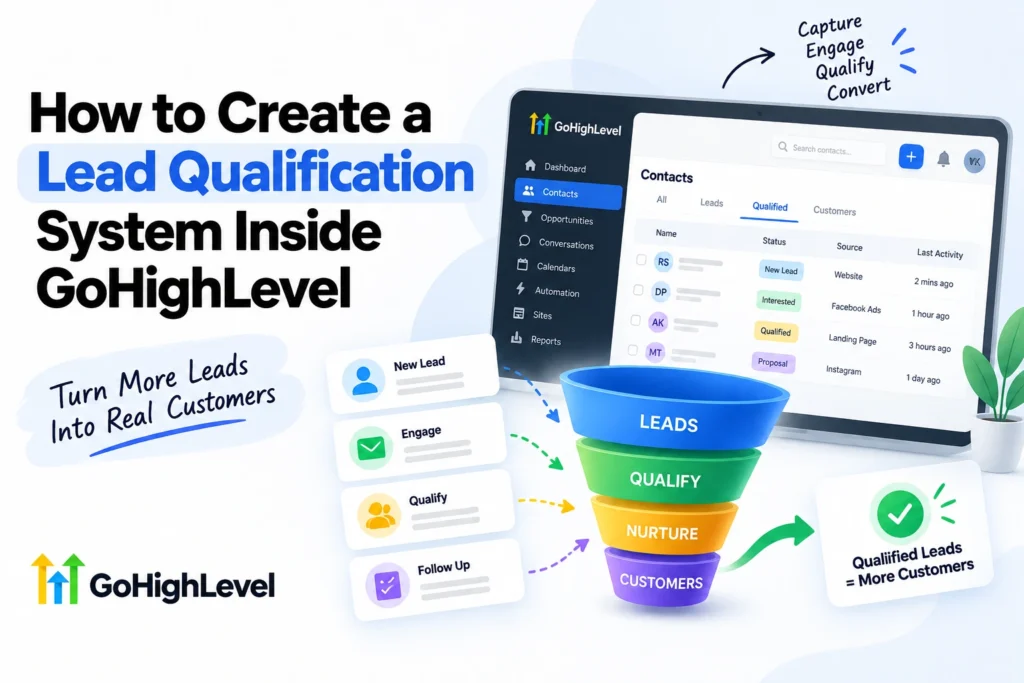
Your GoHighLevel account can contain hundreds or even thousands of contacts. But how many of those contacts are actually worth your sales team’s time?
That’s the question many businesses fail to ask.
A new lead enters the CRM, receives a tag, perhaps gets an automated message, and then sits among dozens of other contacts waiting for someone to decide what to do with them.
The problem isn’t usually the lack of leads.
The problem is knowing which leads deserve attention first.
A good lead qualification system changes that.
Instead of sending every prospect through the same process, businesses can use GoHighLevel to identify the difference between someone who is simply interested and someone who is genuinely ready to buy.
This can make the sales process faster, more organized, and easier to measure.
More importantly, it can help sales teams spend less time chasing unsuitable prospects and more time having conversations with people who have a realistic chance of becoming customers.
The Real Problem Starts After Lead Generation
Businesses invest heavily in generating leads.
They run Google Ads.
They publish SEO content.
They post on social media.
They create landing pages.
They offer free consultations.
All of these activities can bring people into the sales funnel.
But once the lead arrives, what happens?
In many businesses, the process looks something like this:
New inquiry → Salesperson checks CRM → Calls lead → Asks basic questions → Decides whether lead is useful → Follows up manually
This process can work when there are only a few leads.
It becomes difficult when lead volume increases.
A sales representative might spend half the day contacting people who don’t have the required budget, don’t need the service, or aren’t planning to purchase anytime soon.
Meanwhile, a high-value prospect could be waiting hours for a response.
A qualification system solves this imbalance by helping the business prioritize before selling.
What a Good Qualification System Should Actually Do
A lead qualification system should answer four questions:
Who is this person?
What do they need?
How likely are they to buy?
What should happen next?
Those answers can then determine the prospect’s journey.
For example:
A high-intent lead might be sent directly to sales.
A prospect who is interested but not ready might enter a nurture campaign.
A poor-fit inquiry might remain in the CRM without consuming sales resources.
This creates a more intelligent sales process.
And GoHighLevel provides the building blocks required to create it.
Start With the Customer, Not the Automation
One common mistake is opening GoHighLevel and immediately starting to build workflows.
That’s backwards.
Automation should support your sales strategy—not replace it.
Before creating anything, identify the characteristics of your best customers.
Look at your existing customers and ask:
- What industries do they belong to?
- What services do they usually purchase?
- What budget range do they have?
- What problems are they trying to solve?
- How quickly do they usually make decisions?
- What makes them different from leads who don’t convert?
You may find that your best customers have several characteristics in common.
Those characteristics become your qualification signals.
For example, a digital marketing agency might discover that its strongest customers:
- Have established businesses
- Already have a website
- Have a defined marketing budget
- Want measurable lead generation
- Are decision-makers
- Want to begin within the next 30–60 days
That information is much more valuable than simply knowing how many leads arrived last month.
Turn Your Qualification Criteria Into Useful Questions
Once you know what makes a lead valuable, turn those characteristics into questions.
But don’t turn your form into an interrogation.
Every question should have a purpose.
Instead of collecting information simply because your CRM allows it, ask questions that help your team make decisions.
For example:
What are you looking for?
This identifies the service or product the prospect is interested in.
What is your approximate budget?
This helps determine whether the opportunity fits your commercial model.
What are you trying to achieve?
This reveals the prospect’s underlying problem.
When would you like to start?
This provides an indication of urgency.
Are you responsible for making the decision?
This can help identify whether the contact is a decision-maker or an influencer.
The answers can then become data points inside GoHighLevel.
Don’t Make Every Lead Fill Out the Same Form
A business with multiple services may benefit from using different qualification questions for different audiences.
Imagine a company offering:
SEO
Website Development
CRM Automation
Paid Advertising
The information needed to qualify each inquiry isn’t necessarily the same.
An SEO prospect might need questions about:
- Current website
- Target market
- Organic traffic
- SEO goals
- Current SEO investment
A website development prospect may need questions about:
- Existing website
- Number of pages
- Ecommerce requirements
- Required functionality
- Launch timeline
A CRM automation prospect might need questions about:
- Current CRM
- Number of users
- Existing workflows
- Lead volume
- Automation requirements
The more relevant your qualification questions are, the more useful the resulting CRM data becomes.
Build a Qualification Profile for Every Lead
Once information enters GoHighLevel, the objective should be to create a simple profile of the prospect.
Imagine a salesperson opens a contact and sees:
Interested in: CRM Automation
Company Type: B2B Service Business
Budget: $2,000–$5,000
Timeline: Within 30 days
Main Problem: Manual lead follow-up
Decision Maker: Yes
That’s considerably more useful than:
Name + Email + Phone
The salesperson already understands the basic context.
They can prepare for the conversation instead of starting from zero.
Use Lead Scoring to Prioritize Attention
Once the information is structured, lead scoring can help prioritize contacts.
The principle is simple:
Positive signals increase priority.
For example:
- High budget → More points
- Strong business need → More points
- Immediate timeline → More points
- Consultation request → More points
- Decision-maker → More points
On the other hand:
- Outside target market → Lower score
- No clear requirement → Lower score
- Very low budget → Lower score
- Long-term research only → Lower priority
The objective isn’t to create a mathematically perfect prediction.
It is to create a useful prioritization system.
For example:
0–20: Low Priority
The prospect doesn’t currently show strong buying signals.
21–50: Potential
There is some interest, but more nurturing may be required.
51–75: Qualified
The prospect appears to be a good fit and should receive sales attention.
76+: High Intent
The prospect demonstrates strong buying signals and should be contacted quickly.
Your actual thresholds should be based on your business rather than copied from another company.
Add Behavioral Signals to the Picture
Qualification shouldn’t always depend on what someone tells you.
Their actions can also provide useful information.
For example, a prospect who:
- Visits your pricing page
- Returns to your website several times
- Books a consultation
- Opens relevant emails
- Responds to messages
- Requests a proposal
may demonstrate stronger intent than someone who simply downloaded an introductory guide.
This is where behavioral information can make qualification more useful.
A person’s actions and profile can be evaluated together.
Think of it as:
Who they are + What they need + What they do = Lead Priority
Create Different Experiences Instead of One Generic Follow-Up
This is where your qualification system starts creating real business value.
Consider three prospects.
Prospect One: Ready to Buy
They have the right budget, a clear need, and want to start soon.
They shouldn’t receive a generic five-email educational sequence.
They need a fast sales response.
Prospect Two: Interested but Not Ready
They have a genuine need but aren’t planning to buy for several months.
A hard sales approach may push them away.
They are better suited to useful content and periodic follow-up.
Prospect Three: Poor Fit
They don’t match your target customer profile.
Your sales team shouldn’t spend significant time trying to force the opportunity into the pipeline.
The system should recognize these differences.
That’s the real purpose of automation.
Let GoHighLevel Handle the Repetitive Decisions
Once your qualification logic is defined, GoHighLevel workflows can handle repetitive actions.
For example:
New inquiry arrives
↓
Contact information is recorded
↓
Qualification answers are stored
↓
Lead is categorized
↓
Appropriate pipeline action occurs
↓
Relevant communication begins
↓
Sales team receives notification when necessary
The important point is that automation isn’t making the final sales decision.
It’s preparing the lead so that your team can make better decisions faster.
Make Your Pipeline Reflect Reality
A CRM pipeline should reflect what actually happens between first contact and purchase.
A business might use:
Incoming
Under Review
Qualified
Sales Conversation
Proposal
Decision
Won
Lost
The exact terminology doesn’t matter as much as clarity.
When someone looks at the pipeline, they should immediately understand what is happening.
If your pipeline contains 15 stages that nobody uses consistently, it isn’t helping.
Simple and accurate is usually better.
Give Salespeople the Information They Need
A qualification system is only useful if the sales team actually uses the information.
When a qualified opportunity reaches a salesperson, the CRM should make the relevant context easy to see.
For example:
Lead: ABC Business
Requirement: SEO
Budget: $3,000+
Timeline: 30 days
Challenge: Declining organic traffic
Source: Google Search
This information can change the entire opening of a sales conversation.
Instead of spending the first several minutes discovering basic facts, the salesperson can focus on understanding the problem in greater depth.
That creates a more professional buying experience.
The First Response Should Be Automatic
Speed is another important part of qualification.
When someone expresses strong buying intent, waiting until the next business day to acknowledge the inquiry can create unnecessary friction.
An automated confirmation can immediately let the prospect know that their request has been received.
At the same time, the appropriate salesperson can be alerted.
The process could be:
High-intent lead detected
→ Internal notification
→ Contact assigned
→ Confirmation sent
→ Appointment option presented
→ Sales follow-up
This creates momentum while the prospect is still engaged.
Qualification Should Continue During the Sales Process
Lead qualification isn’t something that happens once.
A prospect’s status can change.
Someone who wasn’t ready last month may become ready today.
Someone who initially looked promising may turn out to be a poor fit after a sales conversation.
That’s why qualification should continue throughout the pipeline.
For example:
Qualified → Appointment → Proposal → Negotiation
Each stage provides new information.
Your CRM should reflect those changes.
Use Lost Leads as a Source of Information
One of the most overlooked opportunities in lead qualification is learning from leads that don’t become customers.
Don’t simply mark them as:
Lost
and forget about them.
Look for patterns.
Why were they lost?
Perhaps:
- Budget was too low
- Timing was wrong
- They chose a competitor
- The service wasn’t a good fit
- They stopped responding
- They didn’t have decision-making authority
- The value proposition wasn’t clear
These insights can improve your qualification system.
For example, if most lost opportunities have the same budget limitation, your initial qualification criteria may need to change.
The CRM becomes a learning system rather than just a storage system.
Connect Marketing Data With Sales Outcomes
This is where the system becomes particularly powerful.
You don’t want to know only:
How many leads did we generate?
You want to know:
Which leads became customers?
Suppose you generate:
300 leads from social media
150 leads from Google Ads
100 leads from SEO
At first glance, social media appears to be the strongest channel.
But after qualification, you discover:
Social Media → 20 customers
Google Ads → 25 customers
SEO → 30 customers
Now the picture is different.
SEO generated fewer leads but more customers.
This is why qualification data should eventually be connected to sales and revenue data.
What a Complete GoHighLevel Qualification System Looks Like
A mature system can look something like this:
Traffic
↓
Lead Capture
↓
Qualification Questions
↓
CRM Record
↓
Fit + Intent Evaluation
↓
Lead Priority
↓
Pipeline Placement
↓
Automated Response
↓
Sales Notification
↓
Appointment / Conversation
↓
Proposal
↓
Customer
The system doesn’t eliminate your sales team.
It gives them a better starting point.
Common Problems With Lead Qualification Systems
Too Much Automation
Automation should remove repetitive work, not make your customer experience feel robotic.
Too Many Qualification Questions
If the form becomes difficult to complete, lead volume may fall unnecessarily.
Arbitrary Lead Scores
A scoring system should reflect actual business outcomes.
Ignoring Sales Feedback
Sales teams can identify qualification problems that aren’t obvious from CRM data.
No Follow-Up Strategy
Identifying a qualified lead is pointless if nobody follows up.
Measuring Only Lead Volume
The final objective is revenue—not a large database of contacts.
When Should You Rebuild Your Qualification System?
Your qualification process may need an update if:
- Sales teams complain about lead quality
- Too many leads are being ignored
- High-value leads are being missed
- Marketing generates many leads but few customers
- Salespeople manually sort every inquiry
- Your services or target audience have changed
- Your conversion rates have declined
- Your CRM contains inconsistent lead information
These are signs that the existing process may no longer match the business.
Final Thoughts
The purpose of a GoHighLevel lead qualification system isn’t to create another complicated automation project.
It is to create clarity.
When a new prospect enters your CRM, your team should have a reasonable understanding of who that person is, what they need, how valuable the opportunity could be, and what should happen next.
GoHighLevel can help bring that process together through CRM records, forms, custom fields, workflows, pipelines, communication, appointments, and automation.
But the technology is only one part of the equation.
The strongest systems begin with a clear understanding of the ideal customer and the signals that indicate genuine buying intent.
Once those signals are identified, they can be translated into a practical qualification process.
The result is a sales funnel where not every lead receives the same treatment.
High-intent prospects get attention faster.
Potential customers receive the right nurturing.
Poor-fit leads consume fewer sales resources.
Marketing gets better information about lead quality.
Sales gets better information about opportunities.
And management gets a clearer view of how leads are turning into revenue.
That’s what makes lead qualification valuable.
It isn’t simply about organizing contacts inside GoHighLevel.
It’s about helping your business spend its time on the opportunities most likely to matter.